Top-Rated Pipe and Tube Bending Tools for HVAC, Plumbing, and Workshop Projects
Selecting the right pipe bending tool depends largely on the material diameter and the specific requirements of your plumbing or HVAC application. Whether you are working with small-diameter copper lines for refrigeration or heavy-duty steel tubing for custom fabrication, the mechanics of the tool vary significantly. Options range from compact, lever-style benders designed for precise 180-degree bends in soft metals to robust, floor-mounted manual benders capable of handling larger square and round steel profiles. Understanding the capacity of each tool—specifically the minimum and maximum O.D. (outer diameter) compatibility—ensures you choose the correct equipment for your professional or DIY workshop needs, minimizing material waste and ensuring consistent results across your metalworking projects.
When evaluating these tools, consider the degree of bend capacity and the included accessories. Some kits provide versatile die sets for multiple tubing sizes, while others are optimized for specialized tasks like instrument bending or automotive plumbing. Lever-type tools often provide high control for smaller tubes, whereas ratcheting mechanisms offer improved leverage for HVAC repair jobs. By examining the specific bending range and tool orientation, such as 90-degree versus 180-degree capabilities, you can better align your equipment selection with the demands of your installation or repair. This guide provides a detailed look at the specifications and intended uses for five popular pipe and tube benders currently available.
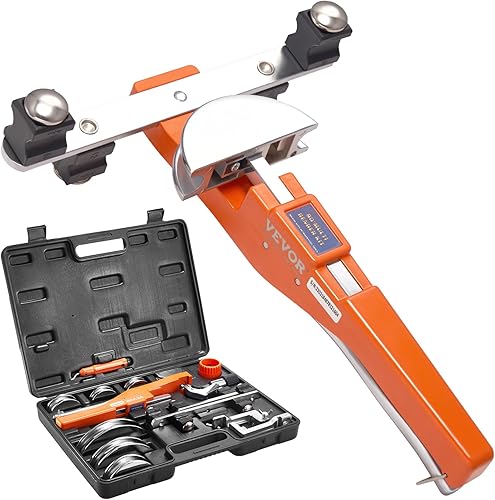
1. VEVOR Pipe Tube Bender, 1/4"-7/8" O.D. Ratcheting Tubing Bender, 90° Forward/Reverse Pipes Bending Tools with 7 Dies and Pipe Cutter for HVAC Air Conditioning Refrigerator Repair | For HVAC Air Conditioning Refrigerator
This ratcheting bender is engineered for HVAC, air conditioning, and refrigerator repair, handling pipes with an outer diameter between 1/4 inch and 7/8 inch. The tool features a 90-degree forward and reverse bending capacity, providing flexibility when working in confined spaces common in refrigeration installations. The package includes seven specific dies to accommodate various tube sizes and a pipe cutter, which may simplify the preparation process for technicians. Because it utilizes a ratcheting mechanism, it is designed to minimize the physical effort required compared to traditional manual benders. This kit appears intended for users who need a comprehensive solution for copper or soft metal tubing maintenance and repair tasks.
Best for: HVAC and refrigeration technicians needing a versatile, multi-size ratcheting toolset.
Check on AmazonHighlights
- Covers 1/4" to 7/8" O.D. range
- Includes seven interchangeable dies
- Features 90° forward and reverse bending
- Supplied with an integrated pipe cutter
Keep in mind
- Limited to 90-degree bend angles
- May not be suitable for heavy-duty steel tubing

2. Maxpeedingrods Manual Pipe and Tube Bends Up to 2" Round and 1-1/2" Square Steel Coated | Up to 2" Round and 1-1/2" Square Steel Coated
Designed for larger-scale fabrication, this manual pipe and tube bender supports round steel up to 2 inches and square steel up to 1-1/2 inches. Its heavy-duty construction is intended for workshop environments where structural metal shaping is required. The unit is finished with a steel coating, suggesting a focus on durability during repetitive bending operations. Unlike smaller handheld tools, this piece of equipment is built for significant metalworking tasks rather than precision HVAC lines. It provides the mechanical leverage necessary to manipulate thicker-walled materials that smaller lever-style benders cannot accommodate. The high user rating suggests it meets the expectations of those performing custom metal fabrication or structural projects.
Best for: Workshops requiring structural steel round and square tubing manipulation.
Check on AmazonHighlights
- Bends round steel up to 2 inches
- Bends square steel up to 1-1/2 inches
- Features a durable steel-coated finish
- Manual design for heavy-duty applications
Keep in mind
- Requires significant workshop footprint
- Less precise for small-diameter copper lines

3. RIDGID 36117 403 Instrument Bender, 3/16-inch Tube Bender for Bends Up to 180 Degrees, Pipe Bender,Black/Silver,Small
The RIDGID 403 instrument bender is a specialized tool designed specifically for bending small-diameter tubing ranging from 3/16 inch. It is engineered to perform precise bends up to 180 degrees, making it a staple for applications requiring tight tolerances, such as instrumentation piping or specialized plumbing. Its compact, black and silver design reflects a focus on portability and ease of use in restricted areas. By allowing for 180-degree bends, it offers more versatility in routing lines compared to tools limited to 90-degree angles. This tool is likely best utilized by professionals who demand high accuracy and repeatable results when working with delicate or high-pressure tubing systems.
Best for: Precision instrumentation and small-diameter tubing requiring 180-degree bends.
Check on AmazonHighlights
- Supports 3/16" tubing
- Capable of 180-degree bend angles
- Compact instrument-grade design
- Renowned brand for plumbing tools
Keep in mind
- Only handles very small tubing sizes
- Not intended for large-scale pipe or steel

4. Flexzion Tube Bender Tool - Manual OD Tubing Bending 3 Size 1/4" 5/16" 3/8" 180 Degree Lever Type Heavy Duty Bend Copper Brass Aluminum & Soft Metal for HVAC Water Gas Pipe Automotive Plumbing (Black)
This Flexzion tool is a manual, lever-type bender designed for 1/4-inch, 5/16-inch, and 3/8-inch tubing. It is built to handle soft metals including copper, brass, and aluminum, making it a useful addition for automotive, water, gas, and general plumbing repairs. The tool is capable of creating 180-degree bends, providing the flexibility needed for complex line routing. Its heavy-duty construction aims to withstand the pressures of manual bending while maintaining the integrity of the tube wall. Because it is a lever-style bender, it relies on the user's manual force, which may provide better tactile feedback for those performing delicate work on thin-walled lines in automotive or HVAC settings.
Best for: Automotive and general plumbing repairs on small-diameter soft metal tubing.
Check on AmazonHighlights
- Bends 1/4", 5/16", and 3/8" tubing
- Performs up to 180-degree bends
- Compatible with copper, brass, and aluminum
- Heavy-duty lever-type construction
Keep in mind
- Manual operation may be physically demanding
- Limited to three specific tubing sizes
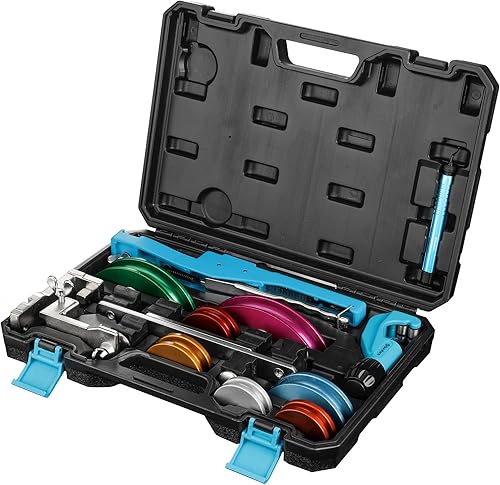
5. DURATECH Tubing Bender Set, Ratcheting Pipe Bender, Cutter and Deburrer | 90° Forward/Reverse Pipe Bending Tools for Tubes from 1/4" to 7/8" O.D., Ideal for HVAC Air Conditioning Refrigerator Repair
The DURATECH tubing bender set is a ratcheting-style tool designed for HVAC and refrigeration maintenance. It accommodates a wide range of O.D. sizes from 1/4 inch to 7/8 inch, offering versatility for technicians who encounter various line dimensions in the field. The set includes a pipe cutter and a deburrer, providing a more complete workflow for pipe preparation and installation. With a 90-degree forward and reverse bending capability, this tool allows for complex routing in tight spaces. The ratcheting design is intended to reduce operator fatigue, which can be beneficial during lengthy service calls. It is marketed as an ideal solution for professionals working on air conditioning and refrigerator systems.
Best for: HVAC professionals needing a comprehensive bender set with prep tools.
Check on AmazonHighlights
- Handles 1/4" to 7/8" O.D. tubes
- Features 90° forward and reverse bending
- Includes essential pipe cutter and deburrer
- Ratcheting mechanism reduces effort
Keep in mind
- Limited to 90-degree bend angles
- May not be ideal for rigid structural steel
How to choose
Bending Capacity and Diameter
When selecting a tube bender, first identify the outer diameter (O.D.) requirements for your specific plumbing or HVAC project. Tools like the VEVOR and DURATECH ratcheting benders offer a versatile range from 1/4" to 7/8" O.D., making them suitable for standard refrigeration and air conditioning tubing. For heavy-duty fabrication involving larger structural components, the Maxpeedingrods manual bender accommodates round steel up to 2" and square steel up to 1-1/2". Always ensure the tool's capacity aligns with your material specifications to prevent deformation or tool failure during the bending process. Precision instruments, such as the RIDGID 403, are specifically designed for smaller, delicate tubing sizes like 3/16".
Bending Angle Capabilities
The maximum bend angle is a critical factor for project geometry. Many manual lever-type tools, including the Flexzion bender and the RIDGID 36117 instrument bender, are capable of achieving precise 180-degree bends, which are essential for creating tight return loops in copper, brass, or aluminum plumbing. In contrast, the VEVOR and DURATECH ratcheting systems are designed for 90-degree forward and reverse bending. These 90-degree tools are often optimized for HVAC repair environments where specific directional changes are required for refrigerant line routing. Choose the angle capacity based on the complexity of your pipe configuration and the space constraints of your installation area.
Drive Mechanism Type
Tube benders generally utilize either a manual lever-action or a ratcheting mechanism. Lever-type benders like the Flexzion offer direct, manual control, which is often favored for smaller, soft metal pipes found in automotive and gas line work. Ratcheting benders, such as the DURATECH and VEVOR sets, utilize a mechanical advantage to assist in bending thicker tubing with less physical strain. These ratcheting models are particularly useful for HVAC technicians performing repetitive bends in tight refrigeration spaces. Evaluate your physical workspace and the frequency of use to determine whether a simple lever system or an assisted ratcheting mechanism provides the necessary efficiency for your tasks.
Material and Tool Compatibility
Different benders are engineered for specific pipe materials. The Flexzion manual bender is explicitly designed for copper, brass, aluminum, and soft metal pipes, prioritizing precision for plumbing and automotive applications. The Maxpeedingrods manual bender is built for heavier steel materials, indicating a higher structural tolerance suitable for metal fabrication. For HVAC-specific tasks, the ratcheting benders from VEVOR and DURATECH focus on the tubing materials standard in air conditioning and refrigerator repair. Verify that your chosen tool is rated for the hardness and wall thickness of your specific piping material to ensure safety and prevent the pipe from kinking or collapsing during the bending operation.
Included Accessories and Kits
Many pipe bending tools are sold as comprehensive kits that improve overall utility. The VEVOR and DURATECH bender sets include multiple dies to accommodate various tubing diameters, along with essential tools like pipe cutters and deburrers. These inclusive kits are ideal for professionals or DIYers who need a complete solution for HVAC installation or repair without purchasing secondary accessories. If you have existing cutting tools, a standalone instrument bender like the RIDGID 403 may be sufficient. However, for those starting a project from scratch, selecting a kit that bundles the bender with the necessary preparation tools can offer greater convenience and ensure all components are properly matched.
Frequently asked questions
Which tool is best for HVAC refrigeration repairs?
For HVAC and refrigeration repair, the VEVOR and DURATECH ratcheting pipe benders are highly suitable options. These tools are specifically designed to handle tubing from 1/4" to 7/8" O.D. and feature 90-degree forward and reverse bending capabilities. Because these sets often include necessary accessories like pipe cutters and deburrers, they provide a comprehensive solution for technicians working with refrigerant lines, allowing for precise routing in confined spaces common in air conditioning and refrigerator systems.
Can I use these tools for square steel tubing?
Most standard tube benders are intended for round copper, brass, or aluminum tubing. If you need to bend square steel, the Maxpeedingrods manual bender is the appropriate choice. It is explicitly rated for 1-1/2" square steel and up to 2" round steel. Always avoid attempting to bend square materials in tools designed exclusively for round HVAC tubing, as the dies will not match the geometry, which can lead to damaged pipe or an ineffective, unsafe bend.
What is the difference between a 90-degree and 180-degree bender?
The primary difference lies in the maximum bend angle the tool can achieve. Benders like the Flexzion and RIDGID 403 are capable of 180-degree bends, which are useful for creating tight U-turns or return loops in plumbing. Alternatively, the ratcheting benders from VEVOR and DURATECH are optimized for 90-degree bends, which are standard for cornering and directional changes in HVAC refrigerant lines. Select the tool based on the specific angle requirements of your project's layout.
Are these benders suitable for automotive brake lines?
Yes, manual lever-type benders like the Flexzion are well-suited for automotive work involving soft metals like copper or aluminum. These tools provide the manual control necessary for delicate lines. However, always verify that the tool's diameter capacity includes your specific tubing size, such as 1/4" or 3/8". Ensure the material of your brake line is compatible with the tool's design, as specialized high-pressure steel lines may require different equipment than standard soft metal plumbing pipes.
Do I need a deburrer when bending pipes?
Yes, a deburrer is a critical tool for ensuring a clean, leak-free connection after you cut your pipe. Many kits, such as the VEVOR and DURATECH sets, include a deburrer as part of the package. Using a deburrer removes sharp edges and metal shavings from the cut ends, which prevents damage to fittings and ensures that your bends and connections are secure. If your bender does not include one, it is a recommended accessory for any pipe installation.
Bottom line
For the broadest range of HVAC and refrigeration applications, the VEVOR and DURATECH ratcheting benders stand out as the most practical choices. Their ability to handle 1/4" to 7/8" O.D. tubing with a ratcheting mechanism makes them efficient for professional repair work where repetitive, precise 90-degree bends are required. These kits are highly functional because they include integrated pipe cutters and deburrers. Conversely, for heavy-duty steel fabrication, the Maxpeedingrods manual bender is the strongest fit due to its unique capacity for 2" round and 1-1/2" square steel. For fine, small-diameter plumbing or instrument work, the RIDGID 403 remains a reliable, dedicated tool for 180-degree bends, ensuring high-quality results in specialized, delicate applications.
Deciding on the right tool depends on your material and the scale of your project. If you are working on HVAC systems, prioritize the ratcheting bender kits for their versatility and included accessories. If your project involves structural fabrication, the Maxpeedingrods manual bender is essential. For plumbing or automotive tasks involving soft metals, choose a lever-type bender like the Flexzion or the RIDGID 403 for their 180-degree capability. Always cross-reference the O.D. size and material type of your tubing against the tool's specifications to ensure compatibility and safety before finalizing your selection.
More from Electrical & Plumbing Tools
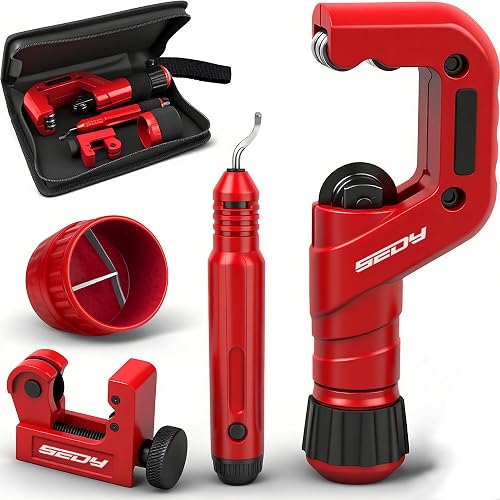
Top-Rated Pipe and Tube Cutters for Plumbing and Metalworking Projects
Compare top-rated pipe and tube cutters, from manual tubing tools to angle grinder wheels, to find the right solution for copper, PVC, and stainless steel.
Read comparison →Top-Rated Pipe and Tubing Cutters for Professional Plumbing and Electrical Work
Compare top-rated pipe cutters for copper, PVC, and industrial hoses. Find the right tool for your project with this breakdown of professional-grade cutters.
Read comparison →
Top-Rated Pipe Cut Off Tools for Plumbing and Electrical Projects
Compare top-rated pipe cutters for PVC, copper, and exhaust systems. Find the right tool for your workshop, from compact tubing cutters to cordless power tools.
Read comparison →