Top Circular Saw Blades for Aluminum and Non-Ferrous Metal Cutting
Selecting the correct circular saw blade for aluminum requires attention to tooth count, arbor size, and material compatibility. Unlike wood-cutting blades, those designed for non-ferrous metals typically feature a Triple Chip Grind (TCG) or specialized Tungsten Carbide Tipped (TCT) teeth to handle the density of aluminum, brass, and copper without binding or overheating. Whether you are using a standard corded handheld saw, a low-RPM dry cut saw, or a stationary miter saw, matching the blade diameter and arbor size to your specific tool is essential for safety and precision. This guide analyzes five distinct options currently available to help you identify the right blade for your specific metalworking or composite cutting project.
When working with aluminum, plastic, or fiberglass, the blade's geometry dictates the quality of the finish and the longevity of the tool. High-tooth counts are standard across these selections to ensure a smooth cut, while specific designs cater to thin-kerf requirements or heavy-duty miter saw applications. It is important to verify your saw's arbor size and recommended RPM before installation, as dry-cut blades often perform best within specific speed ranges. By evaluating the TCT and TCG configurations listed below, you can better understand which blade matches your current equipment setup and material requirements, ensuring your workshop is equipped for clean, accurate non-ferrous metal cuts.

1. SawWorks 6-1/2 Inch 48T Circular Saw Blade Aluminum Cutting Non-Ferrous | TCG for aluminum, plastic, composite & more. Multi-purpose blade, fits most 5/8" Arbor corded and cordless saws.
This 6-1/2 inch blade is engineered with 48 teeth in a Triple Chip Grind (TCG) configuration, specifically designed for cutting aluminum, plastics, and various composite materials. It is built to accommodate both corded and cordless saws that utilize a 5/8-inch arbor, making it a versatile addition for users who need a multi-purpose tool for non-ferrous applications. The design focuses on the unique requirements of non-ferrous cutting, providing a specialized tooth geometry that helps maintain efficiency during operation. Because it is optimized for a range of materials, it serves as a flexible option for workshop tasks involving more than just aluminum. Users should ensure their saw is compatible with the 6-1/2 inch diameter and the standard 5/8-inch arbor before installation to maintain proper fit and function.
Best for: Users needing a versatile blade for cordless or corded saws.
Check on AmazonHighlights
- 48-tooth TCG design
- Compatible with 5/8-inch arbor saws
- Suitable for aluminum and composites
- Designed for corded and cordless tools
Keep in mind
- Limited to 6-1/2 inch saw diameters
- Performance may vary on thicker aluminum stock

2. CRALY 14 Inch 120 Teeth Aluminum and Non-Ferrous Metal Cutting Circular Saw Blade, 1 Inch Arbor, Carbide Tipped, Thin Kerf, Black Ice™, for Thin Aluminum, Plastic, Composite(C14120AL)
The CRALY 14-inch Black Ice blade features 120 carbide-tipped teeth and a thin kerf design, optimized for cutting thin aluminum, plastic, and composite materials. With a 1-inch arbor, this blade is tailored for larger stationary machinery like industrial miter or chop saws. The high tooth count is intended to provide clean, precise cuts on thin-gauge metals, reducing the amount of material removed and potentially easing the workload on the saw motor. Rated at 4.6 out of 5 stars, it is built for users who prioritize precision and finish quality in their metal fabrication work. The thin kerf construction suggests a focus on efficiency, though operators should verify that their specific saw model supports the 1-inch arbor and 14-inch diameter specifications before purchase.
Best for: Precision cutting of thin aluminum on large miter or chop saws.
Check on AmazonHighlights
- 120 carbide-tipped teeth
- Thin kerf for efficient cutting
- Designed for 1-inch arbor saws
- High user rating of 4.6 stars
Keep in mind
- Requires 1-inch arbor compatibility
- May not be suitable for thick aluminum plates

3. Benchmark Abrasives 7 1/4" TCT Circular Saw Blade, 80 Teeth | Tungsten Carbide Tipped, Cuts Aluminum, Brass, Copper, PVC, Fiberglass & Non-Metals, Low RPM Dry Cut Compatible
This 7-1/4 inch Benchmark Abrasives blade features 80 Tungsten Carbide Tipped (TCT) teeth, making it a robust choice for cutting aluminum, brass, copper, and non-metallic materials like PVC and fiberglass. It is explicitly compatible with low-RPM dry cut saws, which is a critical consideration for maintaining blade life and cut quality when working with non-ferrous metals. The 80-tooth count provides a high level of detail for clean edges on various materials. With a 4.5 out of 5-star rating, this blade is recognized for its versatility across different metal and composite substrates. The use of TCT technology is intended to provide durability and heat resistance during the cutting process. Users should confirm their saw's RPM specifications to ensure they align with the dry-cut requirements of this blade.
Best for: General-purpose non-ferrous metal and PVC cutting with dry-cut saws.
Check on AmazonHighlights
- 80 TCT teeth for clean cuts
- Rated 4.5 out of 5 stars
- Compatible with low-RPM dry cut saws
- Cuts brass, copper, and fiberglass
Keep in mind
- Requires specific low-RPM saw compatibility
- Not intended for ferrous metal applications
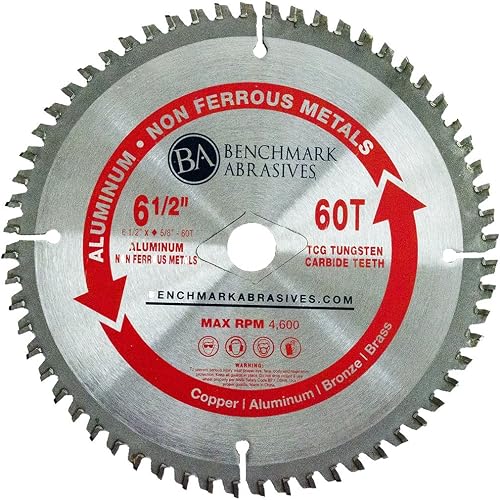
4. Benchmark Abrasives 6 1/2" TCT Circular Saw Blade, 60 Teeth | Tungsten Carbide Tipped, Cuts Aluminum, Brass, Copper, PVC, Fiberglass & Non-Metals, Low RPM Dry Cut Compatible
The 6-1/2 inch version of the Benchmark Abrasives TCT blade offers 60 teeth for users who need a smaller diameter option for their cutting tasks. Like its larger counterpart, it is designed for Tungsten Carbide Tipped performance, handling materials such as aluminum, brass, copper, PVC, and fiberglass. It is compatible with low-RPM dry cut saws, emphasizing controlled cutting speeds to prevent overheating and ensure smooth results. Holding a 4.5 out of 5-star rating, this blade is a reliable choice for workshops requiring a compact solution for thin non-ferrous metals and plastics. Because it utilizes TCT technology, it is built to withstand the demands of various non-metal and soft-metal materials. Prospective users should verify their tool's arbor size and RPM compatibility before selecting this 6-1/2 inch model.
Best for: Compact saws requiring a 6-1/2 inch non-ferrous cutting blade.
Check on AmazonHighlights
- 60 TCT teeth
- Compatible with low-RPM dry cut saws
- Versatile for metal and non-metal materials
- 4.5 out of 5-star user rating
Keep in mind
- May have lower cut capacity than larger blades
- Requires adherence to low-RPM saw limits
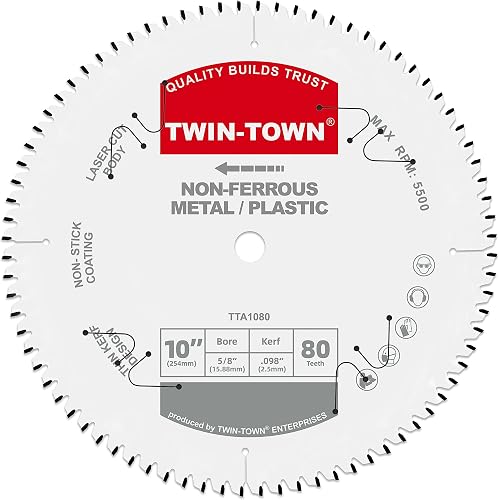
5. TWIN-TOWN 10-Inch 80 Tooth TCG Aluminum Cutting Saw Blade for Miter/Table Saws - Precision Circular Saw Blades for Aluminum, Plastics, Non-Ferrous Metals with 5/8" Arbor
The TWIN-TOWN 10-inch blade is equipped with 80 teeth in a TCG configuration, designed specifically for stationary equipment such as miter and table saws. It features a 5/8-inch arbor, making it a standard fit for many common workshop saws used for cutting aluminum, plastics, and non-ferrous metals. The precision-engineered teeth are meant to deliver clean, accurate cuts in demanding environments, reflected in its 4.6 out of 5-star rating. This blade is positioned as a high-performance option for those who need reliable results in repetitive cutting tasks. Its TCG design is particularly effective for managing the specific challenges of aluminum, preventing grabbing and ensuring a professional finish. Operators should ensure that their miter or table saw is configured for a 10-inch blade before installation.
Best for: Stationary miter and table saw users cutting aluminum and plastics.
Check on AmazonHighlights
- 80-tooth TCG configuration
- Designed for 10-inch miter and table saws
- 5/8-inch arbor compatibility
- High 4.6-star user rating
Keep in mind
- Not designed for handheld circular saws
- Larger diameter restricts use to specific stationary tools
How to choose
Arbor Size Compatibility
Before purchasing, verify your saw’s arbor size to ensure a secure fit. Products like the SawWorks 6-1/2 inch blade and the TWIN-TOWN 10-inch blade are designed for standard 5/8-inch arbors, which are common across many corded and cordless tools. Conversely, larger industrial-grade blades, such as the CRALY 14-inch model, require a 1-inch arbor. Always confirm these specifications against your specific saw model, as an incorrect arbor size will prevent proper installation and safe operation. Mismatching these dimensions is a primary reason for installation failure, so consult your saw manual before selecting your blade to ensure complete hardware compatibility for your workshop.
Tooth Count and Material Finish
Tooth count significantly influences the finish quality of your cuts. Higher tooth counts, such as the 120-tooth CRALY blade or the 80-tooth TWIN-TOWN and Benchmark Abrasives blades, are engineered for cleaner, smoother edges on non-ferrous metals like aluminum. Blades with more teeth reduce the material removal per tooth, which minimizes vibration and burrs during the cutting process. When working with thin aluminum or delicate composites, opting for a blade with a higher tooth count typically yields more professional results. Always balance your need for speed against the desired surface quality, as denser tooth configurations are specifically optimized for precision and refined finishing.
Tungsten Carbide Tipping (TCT)
Tungsten Carbide Tipping, often denoted as TCT, is a critical feature for blades intended to cut aluminum and other non-ferrous metals. The Benchmark Abrasives series, for example, utilizes TCT to maintain sharpness and durability when cutting abrasive materials like aluminum, copper, and fiberglass. Tungsten carbide is significantly harder than standard steel, allowing the blade to maintain its edge through repeated cycles of cutting dense metals. When searching for a long-lasting circular saw blade, prioritizing TCT construction ensures that the teeth remain effective and precise, ultimately providing better value and consistent performance across various non-ferrous metal cutting applications.
Blade Diameter Requirements
Circular saw blades are categorized by diameter, which dictates the maximum cutting depth of your tool. Options range from 6-1/2 inch blades, suitable for portable circular saws like the SawWorks or Benchmark models, up to 14-inch blades intended for stationary miter or chop saws. Ensure you select a diameter that aligns with your saw’s guard capacity. Using a blade that is too large for your saw is unsafe, while one that is too small limits your cutting capacity. Match the blade diameter to the specific requirements of your saw to ensure optimal power transfer and effective cutting performance.
Versatility Across Non-Ferrous Materials
Many aluminum-cutting blades are engineered for multi-purpose utility, handling various non-ferrous materials beyond just aluminum. Products like the SawWorks blade and the TWIN-TOWN 10-inch model are designed to cut plastics, composites, and brass in addition to aluminum. This versatility makes them useful for workshops that handle diverse projects. If your work involves cutting PVC, fiberglass, or multiple types of non-ferrous metals, look for blades that explicitly list these materials in their specifications. Choosing a versatile blade allows you to handle a wider array of cutting tasks without needing to constantly swap equipment, streamlining your workflow across different project types.
Frequently asked questions
Can I use these blades on a standard miter saw?
Yes, many of these blades are compatible with miter saws, provided the arbor size and diameter match your machine’s specifications. For instance, the TWIN-TOWN 10-inch blade is specifically noted for use on miter and table saws. Always verify that the blade's rated RPM and diameter are within the safety limits established by your miter saw manufacturer before installation to ensure the equipment functions correctly and safely during operation.
What is the difference between a 60-tooth and 80-tooth blade for aluminum?
The primary difference is the density of the cutting edge. An 80-tooth blade, such as the Benchmark Abrasives 7-1/4 inch model, provides a finer, smoother finish compared to a 60-tooth version by taking smaller bites of the material. While both are effective for cutting aluminum, the higher tooth count is typically preferred for precision work where minimizing burrs and surface irregularities is essential, whereas lower tooth counts may offer slightly faster cutting speeds.
Are these blades suitable for cutting steel?
No, these blades are specifically engineered for aluminum and non-ferrous metals like copper, brass, and PVC. They are not designed for ferrous metals like steel. Using an aluminum-cutting blade on steel can cause rapid dulling of the tungsten carbide tips, potential blade damage, and hazardous operating conditions. Always restrict your use of these blades to the non-ferrous materials explicitly listed in the product description to maintain blade longevity and safety.
What does TCG mean on a saw blade?
TCG stands for Triple Chip Grind. This tooth geometry is frequently used on blades intended for cutting hard materials like aluminum and plastics. The TCG design features a combination of a flat-topped tooth and a trapezoidal-shaped raker tooth. This configuration helps to balance the cutting load, reduce vibration, and provide a clean finish, which is why it is featured on high-performance aluminum-cutting blades such as the SawWorks 6-1/2 inch and the TWIN-TOWN 10-inch models.
Do I need a specific RPM for these blades?
Some blades, such as the Benchmark Abrasives TCT series, are explicitly noted as being compatible with low RPM dry cut saws. It is vital to check the manufacturer's speed ratings for your specific blade to ensure it matches your saw's capabilities. Running a blade at a speed higher than its rating can be dangerous and may result in premature blade failure or poor cut quality. Always consult the packaging for recommended RPM ranges.
Bottom line
For users prioritizing professional-grade precision on stationary equipment, the TWIN-TOWN 10-inch 80-tooth TCG blade stands out for its specific design for miter and table saws. It effectively balances durability with a clean finish, making it a reliable choice for cutting aluminum and non-ferrous metals. For those working with portable circular saws, the Benchmark Abrasives 7-1/4 inch 80-tooth TCT blade offers excellent versatility across various materials like brass and copper while maintaining a high rating for performance. If you require a specialized solution for thinner materials on heavy-duty equipment, the 120-tooth CRALY 14-inch blade provides the highest tooth density, ensuring minimal vibration and superior edge quality for precise, clean cuts in aluminum and composite sheets.
Deciding on the right blade starts with confirming your saw’s physical requirements: arbor size and blade diameter are non-negotiable specifications. Once those are established, consider the finish quality you need. If your project demands smooth, burr-free edges, lean toward higher tooth counts like the 80-tooth or 120-tooth options. For a workshop with varied needs, select a multi-purpose blade that explicitly covers aluminum, plastics, and non-ferrous metals. Always verify that the blade is intended for your specific saw type—whether portable or stationary—to ensure the best safety and performance results for your specific cutting tasks.
More from Saws & Cutting Tools

Top Circular Saw Blades for Composite Decking: Technical Comparison
Compare top-rated saw blades for composite decking. We review Makita, Norske Tools, Freud, and Diablo options to help you choose the right blade for WPC materia
Read comparison →
Top Circular Saw Blades for Cutting 2x4 Lumber and Framing Projects
Compare top-rated circular saw blades for 2x4 cutting, framing, and finishing. Find the right TCT and carbide-tipped options for your saw and wood project.
Read comparison →
Top Circular Saw Blades for Cutting Laminate and Specialized Materials
Comparing circular saw blades for laminate, fiber cement, and metal cutting. Find the right blade specifications for your next workshop project.
Read comparison →