Top Cross-Cut Saw Blades: A Guide to Choosing the Right Cutting Tool
Selecting the right saw blade is critical for achieving clean, accurate cross-cuts in your woodworking projects. Whether you are using a table saw, miter saw, or a specialized plunge-cut tool, the tooth count and grind geometry dictate the quality of your finish. Blades designed specifically for cross-cutting prioritize a smooth exit from the wood grain, often utilizing high tooth counts to prevent splintering. Conversely, combination blades offer versatility for those who frequently switch between ripping and cross-cutting tasks. This selection of top-rated blades addresses various project needs, from high-precision finish work to heavy-duty material processing, ensuring you have the right tooth configuration for your specific workshop requirements and tool compatibility.
When evaluating potential saw blades, consider the material you are cutting and your primary machine type. A high-tooth-count blade, such as an 80-tooth model, is ideal for miter saws to ensure a polished surface, while 48-tooth or 50-tooth options provide a balanced approach for general cross-cutting. Specialty blades, such as those designed for non-ferrous metals, require different tooth grinds like the Triple Chip Grind (TCG) to maintain material integrity. By matching your blade's specifications—including arbor size and tooth geometry—to your project demands, you can significantly improve your workflow and the overall quality of your cuts.

1. CMT Orange Tools 256.050.10 - Combination Saw Blade D=10 B=5/8 ß=4 ATB 15 + 1 FLAT K=0.102 P=0.071 a=15 | 10-In. Blade Diameter | 50-Tooth Combination Grind | 5/8-In. Arbor | Carbide-Tipped Teeth | Smooth Rip & Crosscuts
The CMT Orange Tools 256.050.10 is a 10-inch combination blade featuring 50 carbide-tipped teeth. Designed with an ATB 15 + 1 flat grind configuration, it is built to handle both ripping and cross-cutting tasks efficiently. With a 5/8-inch arbor, this blade fits standard table and miter saws commonly found in home workshops. The carbide-tipped construction is intended to provide durability across various wood cutting applications, aiming to deliver smooth results whether you are cutting with or across the grain. This blade serves as a versatile workhorse for users who want to minimize blade changes during a project. Its specific tooth geometry is engineered to balance the aggressive material removal required for ripping with the cleaner edge quality needed for cross-cutting, making it a functional choice for general-purpose woodworking needs.
Best for: Users needing a versatile blade for both ripping and cross-cutting.
Check on AmazonHighlights
- Versatile 50-tooth combination grind
- Durable carbide-tipped teeth
- Standard 5/8-inch arbor compatibility
- Designed for smooth cross-cuts and rips
Keep in mind
- May not offer the same finish quality as specialized fine-cut blades
- Performance may vary depending on the specific wood species
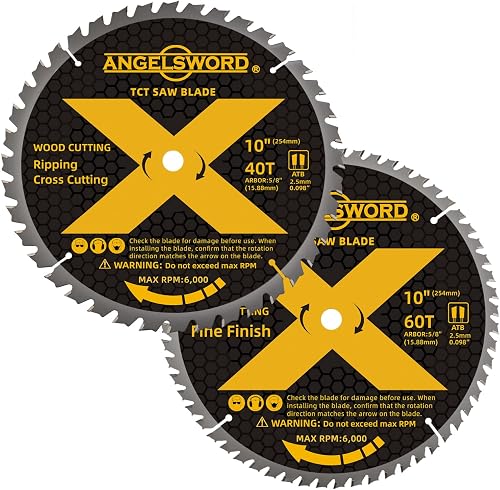
2. ANGELSWORD 10 Inch Table Saw Blade/Miter Saw Blade, 40T for Ripping, Cross Cutting&60T for Fine Finish Wood Cutting, 2 Pack
This two-pack from ANGELSWORD provides a specialized solution for workshops that require different blade configurations for separate tasks. The set includes a 40-tooth blade intended for ripping and cross-cutting, alongside a 60-tooth blade specifically geared toward fine-finish wood cutting. Both blades are designed for 10-inch saws, offering users the ability to swap between tasks depending on the desired finish quality. By providing two distinct tooth counts in one package, this set addresses the need for both speed and precision. The 40T blade is suited for general material processing, while the 60T blade is optimized for clean cuts on delicate or visible surfaces. This bundle is a practical choice for those looking to stock their tool inventory with options for both rough and refined cutting applications.
Best for: Woodworkers who need a dedicated blade for both general cuts and fine finishing.
Check on AmazonHighlights
- Two-pack bundle for varied tasks
- Includes 40T blade for general cutting
- Includes 60T blade for fine finishing
- Compatible with standard 10-inch saws
Keep in mind
- Requires manual blade changes between applications
- Specific arbor size information is not provided for all machines

3. TOMAX 12-Inch 100 Tooth TCG Aluminum and Non-Ferrous Metal Saw Blade with 1-Inch Arbor
The TOMAX 12-inch blade is a specialized tool designed specifically for cutting aluminum and non-ferrous metals. It features 100 teeth with a Triple Chip Grind (TCG), which is the standard geometry for managing harder, non-wood materials without binding or causing damage. This blade is built with a 1-inch arbor, making it suitable for larger capacity saws. Because it is optimized for metals, the high tooth count ensures that the cut remains cool and clean, reducing the likelihood of burrs or deformed edges on the workpiece. It is an essential component for projects involving metal framing, tubing, or decorative aluminum trim. The heavy-duty construction is intended to withstand the resistance encountered when cutting through non-ferrous materials, providing a clean finish that standard wood-cutting blades cannot replicate.
Best for: Cutting aluminum and non-ferrous metal materials.
Check on AmazonHighlights
- High 100-tooth count for precision
- Triple Chip Grind (TCG) for metal
- Large 12-inch diameter
- Designed for 1-inch arbor machines
Keep in mind
- Not intended for general woodworking applications
- Requires a saw capable of handling a 1-inch arbor

4. Festool 495377 Fine Tooth Cross-Cut Saw Blade For TS 55 Plunge Cut Saw - 48 Tooth
The Festool 495377 is a fine-tooth cross-cut blade specifically engineered for the TS 55 plunge-cut saw. With 48 teeth, this blade is designed to produce high-quality, splinter-free cuts in a variety of wood materials. As a proprietary accessory for the Festool system, it is optimized for the precision and performance requirements of the TS 55. The fine-tooth configuration is ideal for finish carpentry, cabinetry, and other applications where the edge quality of the cut is the primary concern. By focusing on cross-cutting performance, this blade helps ensure that users achieve consistent, professional results with their plunge-cut saw. Its design reflects a focus on clean material exit and smooth operation, which is critical when working with veneers, laminates, or solid hardwoods.
Best for: Users of the Festool TS 55 plunge-cut saw needing fine finish cuts.
Check on AmazonHighlights
- Optimized for Festool TS 55 saws
- 48-tooth fine-cut configuration
- Engineered for splinter-free edges
- Specialized for professional cross-cutting
Keep in mind
- Limited to specific Festool saw models
- May not be suitable for heavy-duty ripping tasks

5. Makita A-93681 10-Inch 80 Tooth Micro Polished Mitersaw Blade Silver
The Makita A-93681 is a 10-inch miter saw blade featuring 80 teeth and a micro-polished finish. This blade is designed to provide ultra-smooth cross-cuts, making it an excellent choice for trim work, molding, and fine furniture assembly where visible edges must be perfect. The micro-polished surface is intended to reduce friction, which helps the blade run cooler and last longer through repeated use. With its high tooth count, the blade excels at minimizing tear-out, ensuring that even delicate grain patterns remain intact during the cutting process. As a silver-series blade from Makita, it is built to meet the needs of those using miter saws for high-precision carpentry. Its design focus is entirely on the quality of the finish, rather than the speed of material removal.
Best for: Precision trim work and fine miter saw cross-cuts.
Check on AmazonHighlights
- High 80-tooth count for clean finishes
- Micro-polished surface for reduced friction
- 10-inch diameter for standard miter saws
- Built for precision carpentry and molding
Keep in mind
- Not designed for fast or heavy ripping
- High tooth count may lead to faster heat buildup in thicker stock
How to choose
Tooth Count Considerations
Select a blade based on your specific cutting goals. Higher tooth counts, such as the 100-tooth TOMAX or 80-tooth Makita, are designed for fine finishing or cutting non-ferrous metals. Lower tooth counts, like the 40T option in the ANGELSWORD pack, are better suited for general ripping and cross-cutting tasks. The CMT 50-tooth combination blade serves as a versatile middle ground for those needing a single blade that handles both rip and cross-cut operations effectively. Match the tooth density to your material type to ensure the cleanest possible edge and reduce the strain on your saw motor during operation.
Arbor Compatibility
Always verify the arbor size of your saw before purchasing a replacement blade. The supplied products feature various arbor specifications, including 5/8-inch sizes found on the CMT and standard table saw blades, as well as the 1-inch arbor on the TOMAX 12-inch blade. Using a blade that does not match your saw's arbor size is not possible without proper adapters, and mismatching can lead to improper fitment. Always cross-reference the blade's technical specifications with your saw's manual to confirm compatibility before finalizing your choice for cross-cutting or ripping applications.
Blade Diameter Requirements
The diameter of the blade must match the capacity of your saw. Options listed range from 10-inch blades like the CMT and Makita models, which are common for standard miter and table saws, to the 12-inch TOMAX blade intended for larger capacity machines. The Festool 495377 is specifically engineered for the TS 55 Plunge Cut Saw, highlighting the importance of selecting a blade diameter designed for your specific tool model. Using an incorrectly sized blade can impede the saw's safety mechanisms or prevent the blade guard from functioning as intended during cross-cut or rip operations.
Material Suitability
Identify the material you intend to cut, as blades are optimized for different substances. While most listed blades are suited for wood, the TOMAX 12-inch blade is specialized for aluminum and non-ferrous metals. If you are working primarily with wood, the Festool 48-tooth blade is designed for fine-tooth cross-cutting, while the CMT combination blade offers versatility for both ripping and cross-cutting. Choosing a blade optimized for your specific workpiece ensures better longevity for the carbide-tipped teeth and results in a more precise cut, whether you are working with hardwoods, softwoods, or specialized materials.
Combination vs. Specialized Blades
Decide whether you need a dedicated cross-cut blade or a multi-purpose option. Specialized blades like the Festool 48-tooth or Makita 80-tooth offer high precision for cross-cutting tasks. Conversely, combination blades like the CMT 50-tooth model provide an all-in-one solution for users who frequently switch between ripping and cross-cutting. The ANGELSWORD 2-pack offers a hybrid approach, providing both 40T and 60T blades to cover different cutting requirements. Assess your workflow frequency to determine if a single combination blade or a set of specialized blades will provide the most efficiency for your shop's daily cutting needs.
Frequently asked questions
What is the primary benefit of a carbide-tipped blade?
Carbide-tipped teeth, as seen on the CMT combination blade, are engineered for enhanced durability and edge retention compared to standard steel blades. This material composition allows the teeth to maintain sharpness through multiple cutting cycles, even when working with dense woods. By resisting dulling, carbide tips help ensure that your cross-cuts remain smooth and accurate over the life of the blade, ultimately reducing the frequency of replacements and maintaining consistent performance for various woodworking projects in your workshop.
Can I use the TOMAX 12-inch blade on a 10-inch miter saw?
No, you cannot use the 12-inch TOMAX blade on a saw designed for 10-inch blades. Each saw is manufactured with specific clearance requirements for the blade guard and housing. Installing a blade that exceeds the diameter limit of your saw can cause the blade to strike the housing or prevent the safety guard from closing properly. Always verify the maximum blade diameter allowed by your saw's manufacturer before selecting a blade to ensure safe and proper operation.
Why would I choose an 80-tooth blade over a 40-tooth blade?
An 80-tooth blade, such as the Makita A-93681, is designed for fine finish work where a clean, smooth cut is the priority. The higher tooth count reduces the size of the chips removed, resulting in a cleaner edge on the workpiece. In contrast, a 40-tooth blade, like the one included in the ANGELSWORD pack, is better suited for faster, more aggressive ripping tasks where cut speed is prioritized over the final finish quality of the wood surface.
Are these blades compatible with all table saws?
Compatibility depends entirely on the arbor size and the maximum blade diameter specified by your table saw manufacturer. While many 10-inch blades like the CMT use a standard 5/8-inch arbor, others like the TOMAX require a 1-inch arbor. You must consult your table saw's owner's manual to confirm the required arbor diameter and the maximum blade size the machine can safely accommodate before purchasing any saw blade to ensure a secure and correct fit.
What does 'ATB' mean in the CMT blade description?
ATB stands for Alternate Top Bevel, a common tooth configuration for cross-cutting blades. In this design, the teeth are beveled on the top in an alternating left-and-right pattern. This configuration helps the blade shear through wood fibers more cleanly, which is why it is preferred for cross-cutting operations. It results in a smoother finish compared to flat-ground teeth, making the CMT 50-tooth combination blade effective for achieving high-quality cuts across the grain of the wood.
Bottom line
For users prioritizing versatility and high-quality cross-cuts, the CMT Orange Tools 256.050.10 is the strongest fit. Its 50-tooth combination grind and carbide-tipped construction allow it to handle both ripping and cross-cutting effectively, making it a reliable choice for general shop use. If your focus is strictly on fine-finish cross-cutting, the Festool 495377 or the Makita A-93681 are excellent alternatives, providing higher tooth counts for superior edge quality. The ANGELSWORD 2-pack offers high value for those needing a range of teeth for different tasks, while the TOMAX 12-inch blade remains the clear choice for specialized metal-cutting applications. Selecting the right blade depends on matching the tooth geometry and arbor size to your specific saw requirements.
Deciding on the best blade requires evaluating your specific equipment and material needs. Start by checking your saw's manual to confirm the required arbor size and maximum diameter. If you primarily work with wood and need a balance between speed and precision, a combination blade like the CMT is an ideal starting point. If your projects demand fine-finish cross-cuts, opt for a higher tooth count like the Festool or Makita models. For those needing to cut non-ferrous metals, the TOMAX specialized blade is the appropriate selection. By focusing on your material type and the desired finish quality, you can choose a blade that optimizes your saw's performance while maintaining necessary safety standards.
More from Saws & Cutting Tools

Top Crosscut Circular Saw Blades: Best Options for Woodworking Projects
Upgrade your workshop with the best crosscut circular saw blades. Compare top-rated options for smooth finishing, framing, and general woodcutting precision.
Read comparison →
Top CSST and Copper Pipe Cutters for Plumbing and HVAC Projects
Compare professional-grade CSST and copper pipe cutters. Explore features, capacity ranges, and specialized tool sets for clean, burr-free cuts in your workshop
Read comparison →Top CSST and Tubing Cutters for Professional Plumbing and HVAC Work
Compare professional-grade CSST and tubing cutters from Goldblatt, Knipex, and Ridgid to find the right tool for your plumbing, HVAC, or electrical conduit need
Read comparison →