Top Plywood Saw Blades for Precision Cutting: A Comparative Guide
Selecting the right plywood saw blade is essential for achieving clean edges and minimizing splintering during your woodworking projects. When working with plywood, the blade’s tooth count and geometry play a significant role in determining finish quality. Higher tooth counts are generally preferred for crosscuts and delicate veneers, while specific coatings, such as non-stick or hi-density carbide, help manage heat and friction during extended use. Whether you are using a circular saw, miter saw, or table saw, matching the blade specification to your specific machine arbor and material requirements ensures safer and more efficient operation. This guide examines five distinct options currently available to help you understand their specific design features and intended applications.
The market offers a wide variety of blades tailored for plywood, ranging from 7-1/4 inch circular saw blades to professional-grade 10-inch table saw options. Choosing the correct blade involves balancing your saw's maximum RPM capacity with the blade's specific tooth configuration. Some blades prioritize anti-vibration features and anti-stick coatings, while others focus on high-density carbide teeth for durability. By reviewing the technical specifications—such as arbor size and tooth count—you can narrow down which blade aligns with your equipment. Consider the following comparisons to identify which tool best fits your workshop needs without compromising on the quality of your cuts.

1. Diablo Finish Saw Blade - 7-1/4" Dia., 40 ATB, 5/8" Arbor, 8000 Max RPM | Ideal for Smooth Crosscuts in Hardwood, Softwood & Plywood - Tico Hi-Density Carbide, Perma-Shield Coating - D0740A
This 7-1/4 inch blade features a 40-tooth alternate top bevel (ATB) configuration designed for smooth crosscuts in hardwood, softwood, and plywood. It is engineered with Tico hi-density carbide for material retention and edge sharpness. The blade includes a Perma-Shield coating, which is designed to protect against heat and corrosion during operation. With a 5/8-inch arbor and a maximum capacity of 8000 RPM, this tool is built for circular saws requiring high-speed performance. Its design focuses on versatility across different wood types, making it a reliable choice for general shop tasks where a balance between material removal and finish quality is required. The construction emphasizes durability and consistent performance for standard woodworking applications.
Best for: General circular saw crosscutting
Check on AmazonHighlights
- 40 ATB tooth configuration
- Tico hi-density carbide tips
- Perma-Shield protective coating
- 8000 Max RPM rating
Keep in mind
- May not be optimal for ultra-fine finish work
- Limited to 7-1/4 inch saw configurations

2. WEN BL1080 10-Inch 80-Tooth Carbide-Tipped Ultra-Fine Finish Professional Woodworking Saw Blade for Miter Saws and Table Saws
Designed for professional woodworking, this 10-inch blade utilizes 80 carbide-tipped teeth to deliver an ultra-fine finish. It is specifically engineered for use with miter saws and table saws, providing the high tooth density necessary for clean, chip-free cuts in plywood. The construction focuses on delivering professional-grade results, making it suitable for cabinetry or furniture making where precision is paramount. By increasing the tooth count, this blade minimizes the effort required for sanding post-cut. Its compatibility with both miter and table saws offers flexibility for workshop owners who use multiple cutting stations. The carbide-tipped teeth are intended to maintain edge sharpness over repeated uses, helping to preserve cut quality even when transitioning between different types of wood projects.
Best for: Professional cabinetry and furniture work
Check on AmazonHighlights
- 80-tooth carbide-tipped design
- Compatible with miter and table saws
- Engineered for ultra-fine finish
- 10-inch diameter standard
Keep in mind
- Requires careful alignment for best results
- High tooth count may lead to slower feed rates

3. CMT K20010 200 Teeth Contractor Plywood Saw Blade with 5/8" Bore, 10"
This 10-inch contractor-grade blade is distinguished by its 200-tooth count, which is specifically optimized for cutting plywood. The high concentration of teeth is intended to produce a high-quality edge finish by minimizing tear-out, a common challenge when working with plywood veneers. It features a 5/8-inch bore, ensuring compatibility with most standard 10-inch table saws and miter saws found in contractor workshops. By focusing on a high tooth count, this blade aims to reduce the need for secondary cleanup or sanding on finished edges. It is a specialized tool intended for users who prioritize finishing quality and precision in their plywood projects, reflecting a design philosophy centered on clean, consistent output for professional or serious hobbyist environments.
Best for: Fine plywood edge finishing
Check on AmazonHighlights
- 200-tooth high-density configuration
- Contractor-grade construction
- Standard 5/8-inch bore size
- Optimized for plywood tear-out reduction
Keep in mind
- High tooth count may generate significant heat
- Potentially slower cutting speed due to high tooth density

4. Freud LU80R010: 10" Ultimate Plywood & Melamine Blade
The Freud LU80R010 is a 10-inch blade specifically engineered for plywood and melamine materials. This blade is designed to handle the unique challenges posed by these composite materials, which often include hard veneers or laminates that can be prone to chipping. Its specialized geometry is crafted to provide a clean cut on both the top and bottom surfaces, which is critical when working with double-sided plywood or finished melamine sheets. As a dedicated plywood and melamine blade, it is a focused tool for woodworkers who frequently handle these specific sheet goods. Its construction reflects a commitment to minimizing edge damage, ensuring that the integrity of the veneer or laminate surface is maintained throughout the cutting process.
Best for: Cutting melamine and finished plywood
Check on AmazonHighlights
- 10-inch diameter for table saws
- Specialized for melamine and plywood
- Designed to reduce veneer chipping
- Focuses on clean top and bottom edges
Keep in mind
- Highly specialized for specific materials
- May not be as versatile for general hardwood ripping
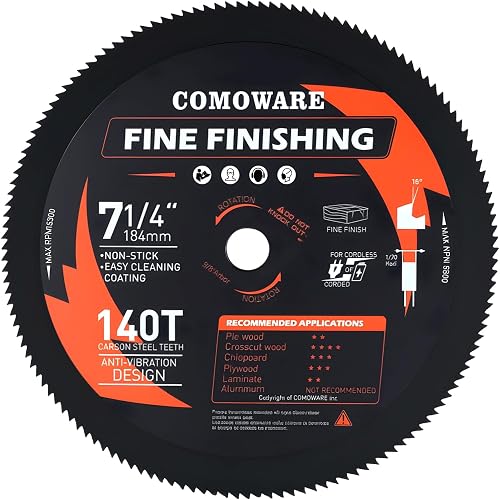
5. COMOWARE 7-1/4“ Circular Saw Blade, 140T Table Saw Blade, 5/8" Arbor, ATB Circular Saw Blade, Anti-Vibration, Teflon Anti-Stick, Miter Saws Blades for Wood, Laminate, Plywood & Hardwoods
This 7-1/4 inch circular saw blade features 140 teeth and an alternate top bevel (ATB) geometry, making it a robust option for various materials including wood, laminate, and plywood. It incorporates anti-vibration technology designed to stabilize the blade during operation, which can help improve the accuracy of cuts. The inclusion of a Teflon anti-stick coating is intended to reduce friction and resin buildup, extending the blade's life and maintaining performance consistency. With a 5/8-inch arbor, it is designed for compatibility with common circular and miter saws. This blade balances advanced coating technology with a high tooth count, providing a versatile solution for users who need to switch between different materials without frequently changing blades.
Best for: Versatile material cutting with circular saws
Check on AmazonHighlights
- 140-tooth ATB configuration
- Anti-vibration design for stability
- Teflon anti-stick coating
- 5/8-inch arbor compatibility
Keep in mind
- High tooth count requires steady feed control
- Performance may vary depending on saw power
How to choose
Tooth Count
When selecting a plywood blade, tooth count is the most significant factor for finish quality. Plywood is prone to splintering, so higher tooth counts are preferred. Options like the CMT K20010 offer 200 teeth for an ultra-smooth finish, while the 40-tooth Diablo D0740A is better suited for general crosscutting. For standard finish work on miter or table saws, 80-tooth blades like the WEN BL1080 provide a balance between cut speed and surface smoothness. Higher counts generally reduce tear-out in delicate veneer surfaces, whereas lower counts are designed for faster material removal.
Blade Diameter and Compatibility
Ensure the blade diameter matches your saw's requirements. Circular saws typically utilize 7-1/4 inch blades, such as the Diablo D0740A or COMOWARE 140T. Table and miter saws generally require 10-inch blades like the Freud LU80R010 or WEN BL1080. Always verify the arbor size, as most standard workshop saws require a 5/8-inch bore. Using an incompatible size can lead to improper mounting, which compromises both safety and cut precision. Check your specific tool manual before purchasing to ensure the blade dimensions are fully supported.
Carbide Composition
Carbide-tipped teeth are essential for maintaining sharpness when cutting abrasive materials like plywood. The Diablo D0740A features Tico Hi-Density Carbide, which is engineered for durability. Similarly, the WEN BL1080 utilizes a carbide-tipped design to ensure long-term performance. Carbide teeth hold an edge significantly longer than standard steel, making them the industry standard for woodworking. When choosing a blade, look for professional-grade carbide construction to ensure that the teeth remain sharp through repeated cuts, maintaining the integrity of your plywood edges over time.
Specialized Coatings
Many modern plywood blades feature specialized coatings to reduce friction and heat buildup. The Diablo D0740A includes a Perma-Shield coating, while the COMOWARE 140T utilizes a Teflon anti-stick coating. These features are designed to minimize resin buildup and prevent binding during long cuts in plywood or laminates. By reducing friction, these coatings help the blade run cooler and smoother, which can extend the overall lifespan of the tool. If you frequently cut materials with high glue content or resin, prioritizing a coated blade can prevent common performance issues.
Tooth Configuration
The tooth geometry, such as ATB (Alternate Top Bevel), dictates how the blade interacts with the wood fibers. The Diablo D0740A and COMOWARE 140T utilize ATB designs, which are effective for clean crosscuts in plywood and hardwoods. This configuration slices through fibers cleanly rather than tearing them. Other blades, like the 200-tooth CMT K20010, are specifically engineered for the high-density requirements of plywood. Understanding whether you need a general-purpose ATB blade or a high-tooth-count specialty blade will ensure you achieve the specific finish quality required for your project.
Frequently asked questions
What is the primary difference between a 40-tooth and 200-tooth plywood blade?
A 40-tooth blade, such as the Diablo D0740A, is designed for general crosscutting and versatility across hardwood, softwood, and plywood. In contrast, the 200-tooth CMT K20010 is a contractor-grade specialty blade engineered specifically for high-precision plywood cuts. The higher tooth count reduces splintering and tear-out on delicate surfaces, providing a much smoother edge than a standard 40-tooth blade. Choose the 40-tooth option for general tasks and the 200-tooth option for final finish work.
Are 10-inch blades interchangeable between table saws and miter saws?
Yes, 10-inch blades like the Freud LU80R010 and the WEN BL1080 are generally compatible with both table saws and miter saws, provided the arbor size matches. Both the Freud and WEN models are designed for these common workshop tools. Always verify that your specific saw model accepts a 5/8-inch bore and that the blade is rated for the RPM range of your machine before installation to ensure safe and accurate operation.
Why do some plywood blades feature anti-stick or anti-vibration coatings?
Coatings like the Perma-Shield on the Diablo D0740A or the Teflon on the COMOWARE 140T serve to reduce friction and prevent resin buildup during operation. Plywood contains glues that can adhere to blades, increasing heat and drag. Anti-stick coatings help the blade glide through the material, while anti-vibration features help stabilize the cut. These additions contribute to a cleaner finish, prevent the blade from binding in the wood, and help prolong the life of the carbide tips.
Can I use a circular saw blade on a table saw?
It depends on the diameter and specifications of the blade. Most 7-1/4 inch circular saw blades, such as the COMOWARE 140T, are designed for handheld circular saws. Table saws typically require 10-inch blades like the Freud LU80R010. You should never attempt to force a blade onto a saw that is not designed for its specific diameter and arbor size. Always refer to your table saw manufacturer's guidelines regarding the required blade diameter to ensure safe usage.
Which blade is best for cutting melamine and plywood?
The Freud LU80R010 is specifically marketed as an ultimate plywood and melamine blade. Melamine is a challenging material because it is prone to chipping, so using a specialized blade is critical for a professional result. While other blades like the WEN BL1080 are excellent for general woodworking and plywood finish, the Freud LU80R010 is uniquely positioned for the specific demands of both plywood and melamine, ensuring clean edges on these difficult-to-cut laminate surfaces.
Bottom line
For users prioritizing the absolute cleanest finish on plywood and melamine, the Freud LU80R010 stands out as the most specialized performer. Its dedicated design for these materials makes it an essential choice for cabinet makers and finish carpenters. If your primary need is a high-tooth-count solution for professional-grade results, the CMT K20010 offers a high-density 200-tooth configuration that is hard to beat for material stability. For the standard workshop, the WEN BL1080 provides a balanced 80-tooth option that hits the sweet spot for both table and miter saw utility. These professional-grade options emphasize clean, tear-free cuts, which are the most critical requirements when working with expensive plywood sheets or fragile laminate surfaces.
Deciding on the right plywood blade depends on your specific tool and the finish quality required. If you are using a circular saw, the Diablo D0740A and COMOWARE 140T offer excellent versatility with anti-friction coatings. For table or miter saw users, match your diameter to the tool—either 7-1/4 inch or 10-inch. If you are cutting standard plywood for basic projects, a 40-tooth to 80-tooth blade is usually sufficient. However, if you are working with veneer or melamine, invest in a higher tooth count, such as the 200-tooth CMT or the specialized Freud LU80R010, to minimize splintering and ensure a professional, clean edge every time.
More from Saws & Cutting Tools

Top Pneumatic and Electric Saws for Professional and DIY Cutting Tasks
Explore top-rated pneumatic reciprocating saws, cordless circular saws, and compact cutting tools designed for metal, wood, and automotive repair projects.
Read comparison →
Top Pneumatic and Manual Pipe Cutters for Workshop and Plumbing Tasks
Explore top-rated pneumatic and manual pipe cutting tools. Compare specialized options for exhaust repair, copper tubing, PVC, and hose cutting for your project
Read comparison →
Top Pneumatic Hose and Tubing Cutters for Workshop and Plumbing Tasks
Compare top-rated pneumatic hose cutters and multipurpose tubing tools. Find the right model for precision cuts on PEX, nylon, and rubber materials today.
Read comparison →